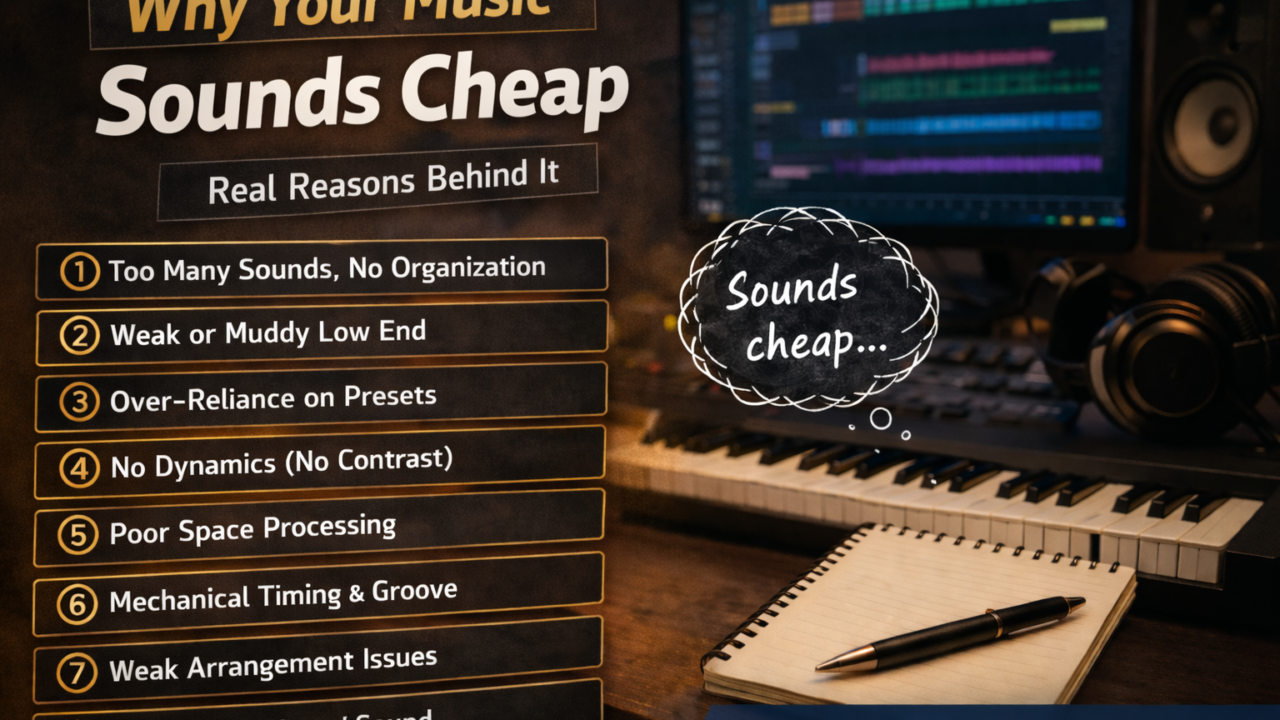
Why Your Music Sounds “Cheap” — From a Composer & Arranger’s Perspective
※This is my personal perspective. Every composer has their own approach, so please take this as a reference.
“Something about this sounds cheap…”
If you’ve ever felt that way, there are actually common reasons behind it.
Many people assume it’s because of poor plugins or low-quality gear.
But in reality, the cause is much simpler.
In this article, I’ll explain the real reasons why music sounds cheap, from a composer/arranger’s perspective.
- 1. Too Many Sounds, No Organization
- 2. Weak or Muddy Low End
- 3. Over-Reliance on Presets
- 4. No Dynamics (No Contrast)
- 5. Poor Space Processing (Reverb Issues)
- 6. Mechanical Timing & Groove
- 7. Weak Arrangement (This is the Core Problem)
- 8. “Cheap” Can Be Intentional
- Why Make It Sound “Cheap” on Purpose?
- 9. In BGM, Lightness Is Often Better
- 10. My Approach to Production
- Summary
- What Really Matters
- About Commissions
1. Too Many Sounds, No Organization
This is one of the most common issues, especially for beginners.
- Too many tracks
- Too many layers
- Yet it still sounds empty
The problem is lack of organization.
Common situations:
- Too many sounds occupying the same frequency range
- Instruments playing the same role (piano + guitar + pad doing the same thing)
- No clear main element
👉 Result: Everything becomes blurry and unfocused → sounds cheap
2. Weak or Muddy Low End
This is extremely important.
On laptops or smartphones, it’s hard to notice, but
low frequencies are the foundation of your track.
Common problems:
- Weak kick
- Unclear bass
- Muddy low end
👉 Result: No power → sounds cheap
※ Too much low end will also ruin clarity, so balance is key
3. Over-Reliance on Presets
Presets are great—but using them “as-is” can be a problem.
Common examples:
- Generic synth sounds
- Weak drum sounds
- No uniqueness
👉 Result: Feels like a stock/template track → sounds cheap
4. No Dynamics (No Contrast)
If everything is the same volume and intensity, people get bored.
Common issues:
- Same energy from start to finish
- Chorus doesn’t feel bigger
- No automation
👉 Result: Flat and artificial
5. Poor Space Processing (Reverb Issues)
Reverb creates depth and atmosphere.
Common mistakes:
- Same reverb on everything
- Too much → blurry
- Too dry → unnatural
👉 Result: No depth → cheap sound
6. Mechanical Timing & Groove
MIDI is powerful—but too perfect sounds unnatural.
Common examples:
- Fully quantized notes
- Same velocity for everything
- No human feel
👉 Result: Feels robotic → cheap
7. Weak Arrangement (This is the Core Problem)
This is very important.
In many cases, the issue is not mixing—it’s the arrangement itself.
Typical examples:
- Weak chorus
- Unclear instrument roles
- No build-up or variation
👉 No matter how much you mix, it won’t improve
8. “Cheap” Can Be Intentional
Up to this point, we’ve talked about problems.
But actually—
👉 “Cheap” can be used intentionally
For example:
- Lightening the sound
- Reducing low end
- Simplifying arrangement
- Using minimal textures
These choices can create a specific aesthetic.
Why Make It Sound “Cheap” on Purpose?
Because it fits the purpose.
Examples:
- Retro style
- Comedy / relaxed vibe
- Vocal-focused tracks
If the music is too rich, it can actually get in the way.
👉 “Cheap” is not bad—it depends on context
9. In BGM, Lightness Is Often Better
This is especially important for background music.
The role of BGM is not to be the main focus—
it’s to support without getting in the way.
For example:
- Store background music
- YouTube talking videos
- Wedding receptions
- Narration background
If the music is too heavy:
- It interferes with conversation
- It distracts from the main content
- It becomes tiring to listen to
What I Do in Practice
When producing BGM, I intentionally:
- Reduce low frequencies
- Limit the number of elements
- Soften the attack
- Avoid overly wide space
This is not lowering quality—
it’s optimizing for purpose
10. My Approach to Production
When I work on a project, I always start with a reference track.
Decide the Density First
Before producing, I determine:
- How dense the arrangement should be
- How strong the low end should be
- How wide the space should feel
Then I decide:
- Rich vs light
- Vocal-focused vs instrumental
- Overall direction
Not Guesswork — Use Clear Criteria
Instead of “just adding sounds,” I focus on:
- Number of elements
- Frequency balance
- Dynamic contrast
This reduces mismatch and ensures consistent quality.
Summary
“Cheap” and “light” may sound similar—but they are completely different.
- Cheap → unintentional
- Light → intentional
Also, perception varies.
Some people may think a track sounds cheap,
while others may feel it sounds just right—or even great.
That’s completely normal.
What Really Matters
👉 Not “what is correct”
👉 But “whether it fits the purpose”
Music quality is not just about feeling—
it’s about design.
Once you understand this,
your productions will improve dramatically.
About Commissions
You can request music production through the following:
1. Official Website (Direct Request)
- Best for flexible communication
- Recommended option
2. Tsunagu (Certified Composer)
- For those who value reviews and track record
- Good for first-time clients
3. ONLIVE Studio (Official Creator)
- For professional, structured projects