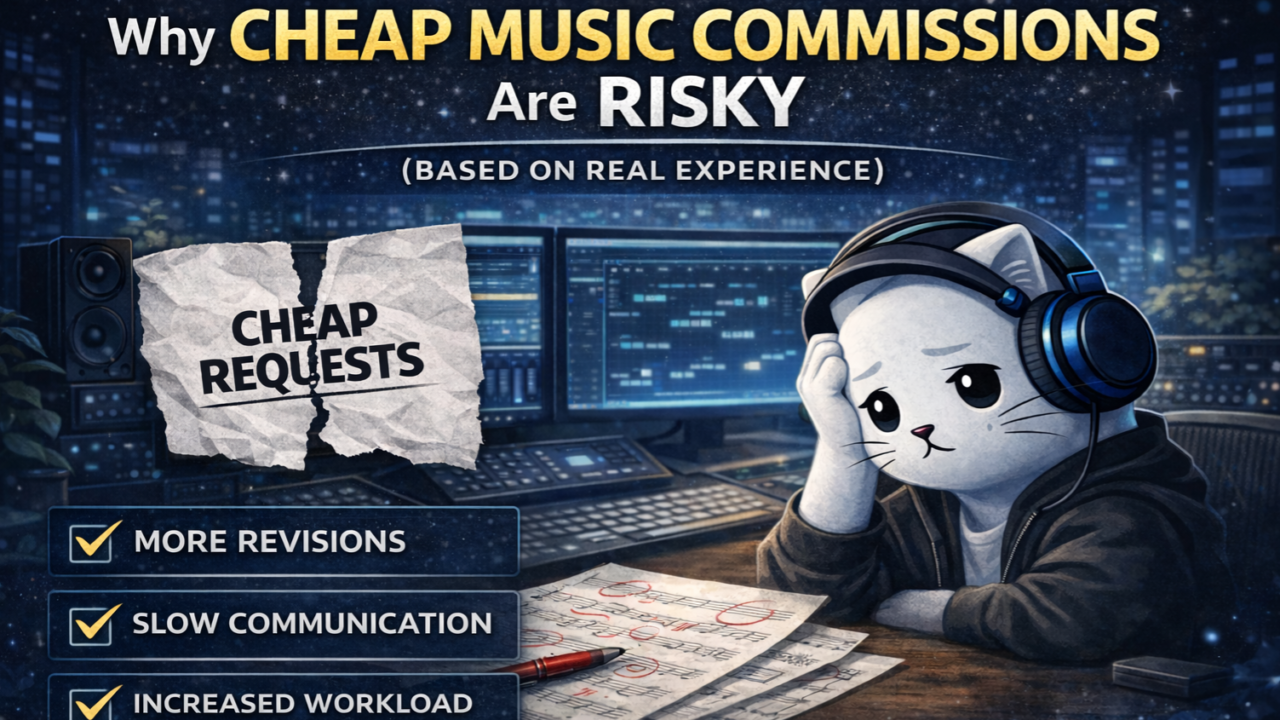
Why Cheap Music Commissions Are Risky (Based on Real Experience)
If you’ve been working in music production for a while,
you will almost certainly run into extremely low-budget requests at some point.
Let me start with the conclusion:
👉 Low price does NOT mean low risk
In fact, from my experience:
👉 The cheaper the project, the higher the chance of trouble
This article is not about saying “cheap is bad.”
Instead, I’ll explain:
- 👉 Why these problems tend to happen
- 👉 Why proper pricing actually matters
All based on real-world experience.
Why Cheap Projects Tend to Have More Revisions
This happens very often.
Low-budget projects tend to come with:
- Unclear direction
- No solid vision of the final result
- No clear decision-making criteria
Which leads to:
👉 “Just try something” → “Hmm… not quite right”
repeated over and over again.
As a result:
- Revisions increase
- Communication drags on
- Work time exceeds expectations
Why Communication Becomes Slow
Another common pattern:
- Replies take days (or even a week)
- Feedback gets delayed
- Decisions are postponed
And this leads to:
👉 Negative impact on other projects
Music production relies heavily on workflow continuity.
When things stop midway:
- Deadlines get pushed back
- Overall efficiency drops
Clients Asking for Discounts Often Require More Time
This is a strong pattern I’ve seen.
Clients who strongly request discounts often:
- Ask for many detailed revisions
- Add requests later in the process
- Don’t clearly organize what they want
Result:
👉 They take significantly more time than standard projects
In other words:
👉 Lower price = higher workload
The “Comparison Problem”
In low-budget projects, it’s common to hear:
- “Someone else offered it cheaper”
- “Another creator did more for this price”
However, music production is:
👉 Not directly comparable
Because every project differs in:
- Environment
- Skill level
- Workflow
- Responsibility scope
When this misunderstanding continues:
- Expectations mismatch
- Miscommunication
- Dissatisfaction
Problems Caused by Split Workflows (Real Case)
To reduce costs, some clients split tasks like:
- Composition
- Arrangement
- Lyrics
- Recording
- Mixing
👉 This approach itself is completely fine.
However:
👉 If not managed properly, it can easily collapse
Real Example
In one project:
- Composition / Arrangement / Lyrics: Me
- Recording / Vocal selection: Another engineer
- Mixing: Me
The structure itself was fine.
But during the process:
👉 The client created a group chat including all parties
This is where things started to break down.
Case 1
The client asked the recording engineer to evaluate:
👉 Composition and arrangement quality
→ Outside the engineer’s role
Case 2
After mixing, the client:
👉 Sent the mix to the engineer for evaluation
→ Refused (not included in their service)
Case 3
The client requested from me:
👉 Work beyond the agreed scope (production-level decisions)
However:
👉 The scope had already been clearly explained before the contract
So I declined as it was outside the agreement.
👉 This led to a mismatch in expectations
What This Shows
The issue was NOT the split workflow itself.
👉 It was how the client managed the process
- Asking the wrong person for decisions
- Mixing responsibilities
- Requesting work outside the agreement
This resulted in:
👉 Unclear roles and unstable production flow
The Core Issue
To summarize:
👉 The problem is not the price — it’s the structure
- Unclear goals
- Undefined responsibilities
- Slow decision-making
No matter how skilled the creator is,
👉 Projects break under these conditions
My Approach
Because of this, I work with the following principle:
👉 Price = Responsibility + Quality Assurance
This includes:
- Clear workflow design
- Defined revision scope
- Responsibility until final delivery
As a result:
- Fewer unnecessary revisions
- Smooth communication
- Stable quality
Final Thoughts
Cheap projects are not inherently bad.
However:
👉 When the goal becomes “just make it cheap,” the production tends to break down
On the other hand:
👉 Well-structured projects lead to better efficiency and higher quality
If you’re considering a project,
I recommend looking not only at:
- Price
but also:
- Process
- Responsibility
- Structure
Contact & Requests
You can reach out through the platforms below:
■ Official Website
https://nekone.jp/
■ ONLIVE Studio (Official Creator)
https://onlive.studio/user/nekone#service
■ Tsunagu (Colorsing Official)
https://tsunagu.cloud/products/3966
Feel free to ask even simple questions like:
👉 “Can you make something like this?”
I’ll help organize your ideas and propose the best approach.