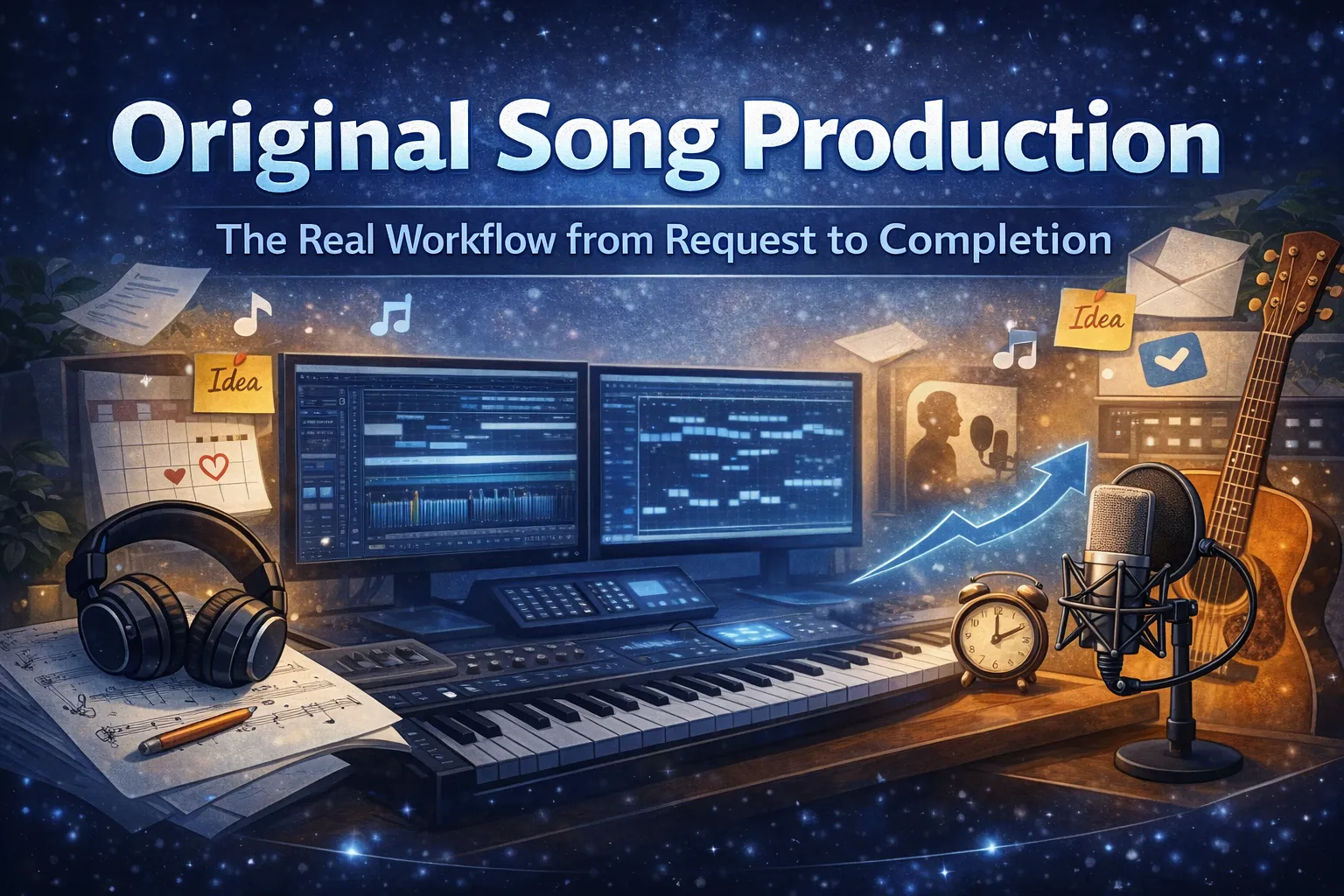
Original Song Production: The Real Workflow from Request to Completion
公開
“What happens after I request a song?”
If this is your first time commissioning an original song,
this is probably the most unclear part.
From my experience, even small misunderstandings early on
can lead to a completely different final result.
So in this article, I’ll walk you through the actual workflow
based on real production experience.
1. Contacting the Composer (This Step Matters the Most)
First, you reach out to the composer.
It really helps if you can provide the following:
- Desired deadline
- Usage (YouTube, streaming, live performance, etc.)
- Reference tracks (very important)
- Must-have requests
- General mood (e.g. bright, emotional — rough ideas are fine)
Honestly,
👉 The presence of reference tracks makes a huge difference
However, one very common issue is:
👉 The reference track and the actual desired result don’t match
This happens more often than you might think.
For example:
- A dark (minor) reference, but the request is “make it bright”
- A ballad reference, but “I want more energy”
- EDM reference, but “make it feel organic/live”
- Simple track, but “make it more full and rich”
This isn’t wrong — it just means:
👉 People focus on different aspects of the same song
For example:
- Melody
- Sound texture
- Arrangement / structure
So,
👉 It really helps if you tell us what exactly you like about the reference
Even a small note like:
- “I like the melody of this song”
- “I like the synth sound here”
can greatly improve accuracy.
2. Quote: Comparing or Choosing One Composer
This part isn’t talked about much, but it’s important.
■ Comparing Multiple Composers
It’s completely normal to ask multiple people for quotes.
However:
👉 In most cases, composers won’t reserve schedule at this stage
Because the project may not be confirmed.
■ Choosing One Composer
If you decide on one composer from the start:
👉 It becomes easier to secure a schedule
In my case,
👉 I prioritize confirmed projects when scheduling
■ About Scheduling (My Policy)
If your request seems likely to proceed,
I may tentatively reserve a schedule.
However, if I receive a response like:
- “I’ll think about it”
- “I’ll check with others”
I will release the tentative slot and accept other work.
Because of that,
👉 The originally proposed schedule is often no longer available later
I prioritize confirmed projects,
so I appreciate your understanding.
3. Defining the Scope (Important to Clarify)
You should clearly decide what you need:
- Composition + Arrangement
- Lyrics (included or not)
- Vocal recording
- Vocal mixing
- Mastering
If this is unclear,
👉 It may lead to “this requires additional cost” later
Production Workflow
4. Demo (Rough Draft)
The composer will first provide a demo.
👉 This is where the direction is decided
If something feels off,
👉 It’s best to say it at this stage
5. Full Production
Once the demo is approved,
the full track is produced.
At this point,
👉 Major changes become difficult
6. Final Check → Mixing
After confirmation, the track goes to mixing.
About Mixing
Mixing is:
👉 Final adjustment of balance and sound quality
So,
👉 It does NOT fundamentally change the song itself
Requests like:
- “Make it cooler”
- “Change the vibe”
are usually not possible at this stage.
👉 Arrangement and composition cannot be fixed in mixing
Important Notes (To Avoid Misunderstandings)
■ About Revisions
Many composers set revision limits.
In my case:
👉 Revisions are unlimited
However:
👉 I clearly separate “revisions” and “remakes”
For example:
- Restarting from scratch midway
- Changing direction significantly late in the process
These are treated as:
👉 Remakes (additional cost required)
■ Response Time Affects Delivery
The workflow is:
Check → Revise → Check
So:
👉 Delayed responses can delay delivery
■ The Demo Stage is Crucial
The earlier you fix direction, the better.
■ Vocal Recording Limitations
After recording, requests like:
- “Change how this line is sung”
- “Make it more emotional”
👉 Cannot usually be fixed in mixing
Because:
👉 Performance is determined at the recording stage
■ Delivery Format
It’s best to confirm in advance:
- WAV / MP3
- Instrumental version
- Stems (separate tracks)
■ Clear Feedback Improves Results
Instead of:
“Something feels off”
Try:
👉 “Bring the synth forward in the chorus”
■ Sound Varies by Device
Smartphones, headphones, speakers
all sound different.
👉 Check in multiple environments if possible
Summary
👉 Most of the result is decided before production and during the demo stage
- Initial information
- Communication style
- Demo feedback
Improving these will greatly reduce:
👉 “This isn’t what I expected”
Request Information
You can request my services through the following:
1. Official Website (Direct Request)
Best if you want flexible communication
and a more customized approach
2. Tsunagu (Colorsing Official Creator)
👉 https://tsunagu.cloud/products/3966
Best for those who value reviews and reliability
Ranked #1 in original song / arrangement category
3. ONLIVE Studio (Official Creator)
👉 https://onlive.studio/user/nekone#service
Best for professional, structured requests
👉 Feel free to choose whichever platform suits your needs.
この記事を書いた人

作曲編曲家(JASRAC信託契約)
Nekone(ねこ音)
作曲・編曲・BGM制作を行うクリエイター。JASRAC信託契約により、権利関係が明確な楽曲提供を行っています。Colorsing・ONLIVE STUDIOの公認クリエイターとして活動。安心して依頼できる音楽制作やノウハウを発信しています。
Composer / Music Producer (BGM). Music with clear copyright management (JASRAC). Official creator on Colorsing & ONLIVE STUDIO. Available for commissions.
\ Follow me /